

Ken Trapp
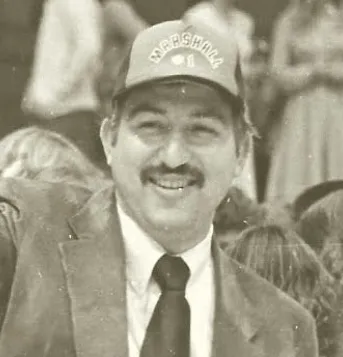
Ken Trapp is in no mood to talk. Later, sure, but not right now.
Right now, Trapp is mid-round in the Persimmon Country Club championships and, for reasons known only to him, has answered a phone call from a virtual stranger shortly after walking off a green that has him seeing red.
“I just three-putted, and I’m pissed,” he explains.
A few days later the memory of his exhibition of excessive putting has faded enough that Trapp is downright loquacious as he explains to that same caller that, while he may be years removed from his last coaching gig, the competitive drive for which he was known (though not always loved) hasn’t gone anywhere. Thus, he explains, there is zero excuse for a guy who takes golf as seriously as he to be freaking three putting in a freaking club championship.
Clearly, his competitive nature had much to do with Trapp winning a whole lot of games over his 35-plus years coaching womens basketball (and other sports) at Marshall High and Clark College. And, after supposedly retiring, it’s what brought him off the bench to coach again at Concordia College and at Clackamas High, which led to even more winning.
What Trapp didn’t always win was an abundance of friends among his foes. Jan Watt is a pal now, and a close one at that. But back in the earliest days of PIL girls basketball, when Trapp’s Minutemaids were routinely beating the brakes off Watt’s Cleveland squads and having a whole lot of fun doing it? Let’s just say it took a while for their friendship to blossom.
“Ken’s take back then would have been something like, ‘No wonder you don’t like us; we’re beating the hell out of you,’” says Watt, a fellow PIL Hall of Fame inductee. “He came across in what could be called a dominating manner. But he had an absolute determination to ensure his kids could have some success, because the kids in his district often didn’t have it off the court.”
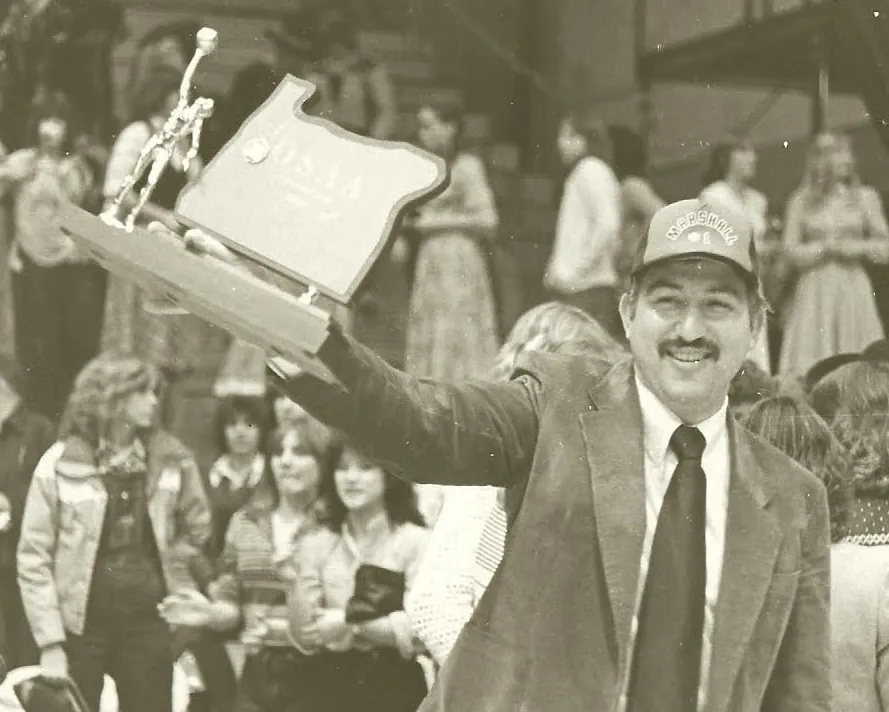
There’s no arguing that Trapp didn’t succeed to that end. In the 11 years he coached girls basketball at Marshall, his teams won five PIL championships and back-to-back state titles in 1981 and 1982.
Trapp also coached softball for 10 years, leading his teams to two PIL crowns.
It was more of the same at Clark, where his teams won nine straight league championships and two Northwest Community College titles.
That kind of sustained success might not engender a lot of love among the coach’s competitors, but among his players? Well, that’s a different story.
PIL Hall of Famer Karyl Wing-DeWitt earned 12 letters and made 10 All-PIL and two All-State teams at Marshall in basketball, soccer and softball, most of them while playing for Trapp. Her introduction to him left an impression that endured through her playing careers at Marshall and the University of Portland and her coaching years at Marshall and Barlow.
“I met Ken when I was in 8th grade,” says Wing-DeWitt. “He came up to me after a basketball game and asked how we did. I started telling him that I had a good game and how many points I’d scored, and he cuts me off and says, ‘Stop right there. I asked how your team did, and there’s no I in team.’ That had a huge impact on me.
“He was a tireless advocate for his players and girls basketball in general. He did have a reputation among other coaches, and other teams didn’t always love to play his teams. But his players knew him differently than others did. We knew he was really a softie.”
Little League, Swimming and Horses
Coaching basketball hadn’t even been on Trapp’s radar. Neither was any coaching, for that matter. He was primarily a baseball player growing up, his equestrian skills notwithstanding.
“I never played much basketball when I was young,” he says. “My parents ran a boarding school downtown on 10th and Montgomery. We lived on the Park Blocks and I went to St. Helen’s Hall, where there wasn’t much going on. On Tuesdays we went horseback riding and Thursdays we’d go swimming at the Jewish Community Center.
“I guess you could say I was a horseman,” Trapp adds with a laugh. “My first year in a horse show, there were seven horses and I took seventh and got a brown ribbon. I still have it.”
Trapp played Little League and was in the first group of kids who got to inaugurate the new baseball complex at Alpenrose Dairy. Playing in the Lincoln High district, Trapp watched with envy as a team from the Rose City district advanced all the way to the Little League World Series in Williamsport.
Once he got to Madison, Trapp would wind up playing with members of that team, including PIL Hall of Famers Rick Wise and Keith Lampard.
“I liked to say I didn’t play on their team, they played on MY team,” he cracks.
Trapp considered himself a “pretty good baseball player, but there were a lot of good baseball players at Madison.”
He cracked the varsity lineup just in time to play on the Senators’ 1963 state title team. Trapp also played freshman and JV basketball before making the varsity his final two years.
“I worked my tail off,” he says. “Freshman year I hardly ever played. The next year on the JV team I scored a point here and there. Junior year I made varsity but didn’t play much, and then senior year I became the starting guard. I never quit. I gave everything I had and finally made it. I knew what it was like to work hard and sit on the bench, and I always had that in mind whatever sport I was coaching over the years. It was a lesson.”
College Then a Course Correction
After Madison, Trapp entered Lewis & Clark College without a career in mind and left the same way. But he had a business degree and landed a sales job with Heinz then another one working in GMC’s truck division.
“I was sitting behind a desk, and it was kind of boring,” he says. “At lunch I’d go to the golf course and putt.”
Trapp decided to leave the business world, went back to Lewis & Clark to get his teaching certificate and got hired at Marshall after student teaching there.
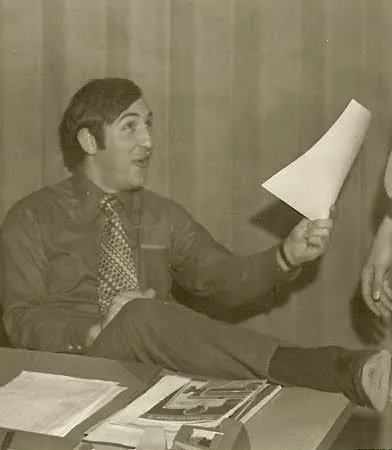
“I was hired as a business teacher and JV baseball coach, which was the sport I wanted to coach,” Trapp says. “But Al Simpson (another future PIL Hall of Famer) had just been hired, so there was no future for me in that job.”
Trapp coached the JVs for “seven or eight years” and also became a football assistant during that time. Then when Marshall added boys soccer, he was asked to coach that team.
“I didn’t know anything about soccer other than you put the ball in one net and didn’t let it go in the other.”
So, of course, he took the job, coaching the Marshall boys for one year before switching to the girls team, “now that I knew so much about soccer,” he says with a laugh.
Trapp coached the Marshall girls for four years and, while he may have been short on traditional soccer knowledge, he made up for with what his fans would call ingenuity and his foes would call…frustrating? Aggravating? Diabolical?
You decide.
“One time we were playing Wilson and we never beat Wilson,” Trapp remembers. “The weather was terrible, but we’re playing them tough and go ahead 1-0. In those days when a ball would go out of bounds, the clock kept running. After we get the lead, I tell my players to kick the ball as far out of bounds as you can and don’t go after it. We won, and I think somebody from Wilson may still be running after that ball.”
This much is certain. Trapp is still laughing about it.
The coach applied the same creative thinking to softball.
“One year we’re in the playoffs and we’re playing out in Hillsboro,” Trapp recalls. “They’re beating us 5-0 in the third inning. I see a huge black cloud coming. So, I slowed the game down. I walked out to talk to the pitcher every time I could, trying not to get to the fifth inning when it would be an official game. In the fourth inning, the rain comes crashing down and they call the game. We go back next day and we beat them. That coach was so mad at me, but the kids were just fired up.”
Haters Gonna Hate
Let the haters hate, was Trapp’s philosophy.
“All I cared about was the kids,” he says. “Kids from Southeast Portland were special. It was a tough neighborhood, but if they believed in you and what you were doing, they jumped in with everything they had. My kids just didn’t think they were supposed to lose.”
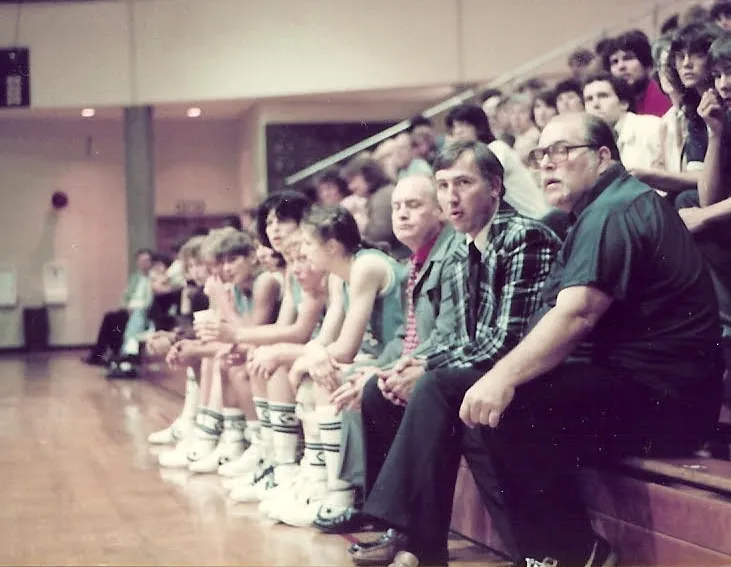
And they didn’t lose much on Trapp’s watch, especially in basketball, the sport he helmed at Marshall when it became officially sanctioned and one whose existence as a PIL sport in those early days may be owed to Trapp, according to Watt.
“Without Ken, girls basketball in the PIL would never have been on the map,” she says. “He was an unwavering advocate for girls basketball and athletics at a time when the PIL was rudderless. I have so much admiration for Ken, and I think everyone in the PIL owes a debt of gratitude to him.”
Watt’s evolution from foe to friend was aided greatly by her familiarity with Trapp’s wife, Joan, who was a teaching colleague at Cleveland.
“I met Ken first and then I met Joan, who was the most patient, gracious, unassuming person. I said to her, ‘Oh my God, how can you be married to that guy?” Watt says, bursting into laughter.
Trapp takes it all in stride.
“I know she hated me; a bunch of them did,” he says. “I probably should have been a little nicer, I guess, but I think the kids had a lot of fun.”
Trapp left Marshall for Clark College in 1985, retired in 2020 and after being coaxed out of retirement to spend two years at Concordia and another at Clackamas High, finally retired for good.
He says he is eternally grateful to have been able to coach at Marshall with “one of my best friends, John Hughes" and for the mentoring of legendary Marshall coaches Darrell Everett, Don Francin and Charlie Lehman.
Trapp and Joan, his wife of “52 wonderful years” raised a daughter and two sons, one of whom is disabled and lives at home with them.
“He’s 40 and a great kid,” Trapp says. “When he was in high school we had him in the weight-training class with the athletes. They bought a special machine for him. He’d be on the sidelines at the football games, and I’d take him into the locker room because I wanted him to see how kids got chewed out. He’s in a power chair but I’ve always wanted him to have the biggest experiences he could have without always being able to fully participate in them.”
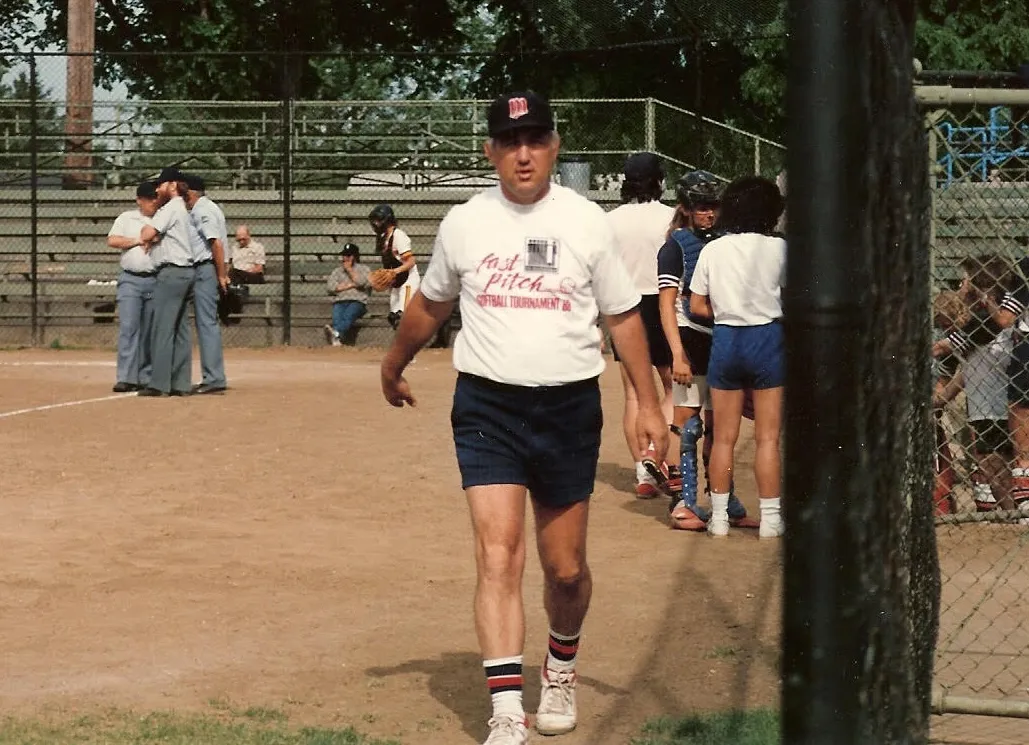
A former fast-pitch softball player, Trapp says he now plays golf most days. “That’s my four hours,” he says. “The rest of the day is everybody else’s.”
After devoting so much of the last three-plus decades to everybody else, few people would begrudge Trapp some me time – even those in his past whose nerves he may have devoted some overtime to grinding on.
Like the former opposing coach he ran into a while back.
“She was one of those who I don’t think liked me much back in the day,” Trapp says. "She came up to me and said, ‘Ken, I want to tell you that you made a big difference in womens basketball. Thank you.’ That was kind of a compliment, I think.”
If Trapp's looking for an argument, and from the sounds of things, that wouldn't be out of character, he's come to the wrong place.
Do you know Ken Trapp? If you’d like to reconnect, he canbe reached at [email protected]
Member Spotlight
Ken Trapp is in no mood to talk. Later, sure, but not right now.
Right now, Trapp is mid-round in the Persimmon Country Club championships and, for reasons known only to him, has answered a phone call from a virtual stranger shortly after walking off a green that has him seeing red.
“I just three-putted, and I’m pissed,” he explains.
A few days later the memory of his exhibition of excessive putting has faded enough that Trapp is downright loquacious as he explains to that same caller that, while he may be years removed from his last coaching gig, the competitive drive for which he was known (though not always loved) hasn’t gone anywhere. Thus, he explains, there is zero excuse for a guy who takes golf as seriously as he to be freaking three putting in a freaking club championship.
Clearly, his competitive nature had much to do with Trapp winning a whole lot of games over his 35-plus years coaching womens basketball (and other sports) at Marshall High and Clark College. And, after supposedly retiring, it’s what brought him off the bench to coach again at Concordia College and at Clackamas High, which led to even more winning.
What Trapp didn’t always win was an abundance of friends among his foes. Jan Watt is a pal now, and a close one at that. But back in the earliest days of PIL girls basketball, when Trapp’s Minutemaids were routinely beating the brakes off Watt’s Cleveland squads and having a whole lot of fun doing it? Let’s just say it took a while for their friendship to blossom.
“Ken’s take back then would have been something like, ‘No wonder you don’t like us; we’re beating the hell out of you,’” says Watt, a fellow PIL Hall of Fame inductee. “He came across in what could be called a dominating manner. But he had an absolute determination to ensure his kids could have some success, because the kids in his district often didn’t have it off the court.”
There’s no arguing that Trapp didn’t succeed to that end. In the 11 years he coached girls basketball at Marshall, his teams won five PIL championships and back-to-back state titles in 1981 and 1982.
Trapp also coached softball for 10 years, leading his teams to two PIL crowns.
It was more of the same at Clark, where his teams won nine straight league championships and two Northwest Community College titles.
That kind of sustained success might not engender a lot of love among the coach’s competitors, but among his players? Well, that’s a different story.
PIL Hall of Famer Karyl Wing-DeWitt earned 12 letters and made 10 All-PIL and two All-State teams at Marshall in basketball, soccer and softball, most of them while playing for Trapp. Her introduction to him left an impression that endured through her playing careers at Marshall and the University of Portland and her coaching years at Marshall and Barlow.
“I met Ken when I was in 8th grade,” says Wing-DeWitt. “He came up to me after a basketball game and asked how we did. I started telling him that I had a good game and how many points I’d scored, and he cuts me off and says, ‘Stop right there. I asked how your team did, and there’s no I in team.’ That had a huge impact on me.
“He was a tireless advocate for his players and girls basketball in general. He did have a reputation among other coaches, and other teams didn’t always love to play his teams. But his players knew him differently than others did. We knew he was really a softie.”
Little League, Swimming and Horses
Coaching basketball hadn’t even been on Trapp’s radar. Neither was any coaching, for that matter. He was primarily a baseball player growing up, his equestrian skills notwithstanding.
“I never played much basketball when I was young,” he says. “My parents ran a boarding school downtown on 10th and Montgomery. We lived on the Park Blocks and I went to St. Helen’s Hall, where there wasn’t much going on. On Tuesdays we went horseback riding and Thursdays we’d go swimming at the Jewish Community Center.
“I guess you could say I was a horseman,” Trapp adds with a laugh. “My first year in a horse show, there were seven horses and I took seventh and got a brown ribbon. I still have it.”
Trapp played Little League and was in the first group of kids who got to inaugurate the new baseball complex at Alpenrose Dairy. Playing in the Lincoln High district, Trapp watched with envy as a team from the Rose City district advanced all the way to the Little League World Series in Williamsport.
Once he got to Madison, Trapp would wind up playing with members of that team, including PIL Hall of Famers Rick Wise and Keith Lampard.
“I liked to say I didn’t play on their team, they played on MY team,” he cracks.
Trapp considered himself a “pretty good baseball player, but there were a lot of good baseball players at Madison.”
He cracked the varsity lineup just in time to play on the Senators’ 1963 state title team. Trapp also played freshman and JV basketball before making the varsity his final two years.
“I worked my tail off,” he says. “Freshman year I hardly ever played. The next year on the JV team I scored a point here and there. Junior year I made varsity but didn’t play much, and then senior year I became the starting guard. I never quit. I gave everything I had and finally made it. I knew what it was like to work hard and sit on the bench, and I always had that in mind whatever sport I was coaching over the years. It was a lesson.”
College Then a Course Correction
After Madison, Trapp entered Lewis & Clark College without a career in mind and left the same way. But he had a business degree and landed a sales job with Heinz then another one working in GMC’s truck division.
“I was sitting behind a desk, and it was kind of boring,” he says. “At lunch I’d go to the golf course and putt.”
Trapp decided to leave the business world, went back to Lewis & Clark to get his teaching certificate and got hired at Marshall after student teaching there.
“I was hired as a business teacher and JV baseball coach, which was the sport I wanted to coach,” Trapp says. “But Al Simpson (another future PIL Hall of Famer) had just been hired, so there was no future for me in that job.”
Trapp coached the JVs for “seven or eight years” and also became a football assistant during that time. Then when Marshall added boys soccer, he was asked to coach that team.
“I didn’t know anything about soccer other than you put the ball in one net and didn’t let it go in the other.”
So, of course, he took the job, coaching the Marshall boys for one year before switching to the girls team, “now that I knew so much about soccer,” he says with a laugh.
Trapp coached the Marshall girls for four years and, while he may have been short on traditional soccer knowledge, he made up for with what his fans would call ingenuity and his foes would call…frustrating? Aggravating? Diabolical?
You decide.
“One time we were playing Wilson and we never beat Wilson,” Trapp remembers. “The weather was terrible, but we’re playing them tough and go ahead 1-0. In those days when a ball would go out of bounds, the clock kept running. After we get the lead, I tell my players to kick the ball as far out of bounds as you can and don’t go after it. We won, and I think somebody from Wilson may still be running after that ball.”
This much is certain. Trapp is still laughing about it.
The coach applied the same creative thinking to softball.
“One year we’re in the playoffs and we’re playing out in Hillsboro,” Trapp recalls. “They’re beating us 5-0 in the third inning. I see a huge black cloud coming. So, I slowed the game down. I walked out to talk to the pitcher every time I could, trying not to get to the fifth inning when it would be an official game. In the fourth inning, the rain comes crashing down and they call the game. We go back next day and we beat them. That coach was so mad at me, but the kids were just fired up.”
Haters Gonna Hate
Let the haters hate, was Trapp’s philosophy.
“All I cared about was the kids,” he says. “Kids from Southeast Portland were special. It was a tough neighborhood, but if they believed in you and what you were doing, they jumped in with everything they had. My kids just didn’t think they were supposed to lose.”
And they didn’t lose much on Trapp’s watch, especially in basketball, the sport he helmed at Marshall when it became officially sanctioned and one whose existence as a PIL sport in those early days may be owed to Trapp, according to Watt.
“Without Ken, girls basketball in the PIL would never have been on the map,” she says. “He was an unwavering advocate for girls basketball and athletics at a time when the PIL was rudderless. I have so much admiration for Ken, and I think everyone in the PIL owes a debt of gratitude to him.”
Watt’s evolution from foe to friend was aided greatly by her familiarity with Trapp’s wife, Joan, who was a teaching colleague at Cleveland.
“I met Ken first and then I met Joan, who was the most patient, gracious, unassuming person. I said to her, ‘Oh my God, how can you be married to that guy?” Watt says, bursting into laughter.
Trapp takes it all in stride.
“I know she hated me; a bunch of them did,” he says. “I probably should have been a little nicer, I guess, but I think the kids had a lot of fun.”
Trapp left Marshall for Clark College in 1985, retired in 2020 and after being coaxed out of retirement to spend two years at Concordia and another at Clackamas High, finally retired for good.
He says he is eternally grateful to have been able to coach at Marshall with “one of my best friends, John Hughes" and for the mentoring of legendary Marshall coaches Darrell Everett, Don Francin and Charlie Lehman.
Trapp and Joan, his wife of “52 wonderful years” raised a daughter and two sons, one of whom is disabled and lives at home with them.
“He’s 40 and a great kid,” Trapp says. “When he was in high school we had him in the weight-training class with the athletes. They bought a special machine for him. He’d be on the sidelines at the football games, and I’d take him into the locker room because I wanted him to see how kids got chewed out. He’s in a power chair but I’ve always wanted him to have the biggest experiences he could have without always being able to fully participate in them.”
A former fast-pitch softball player, Trapp says he now plays golf most days. “That’s my four hours,” he says. “The rest of the day is everybody else’s.”
After devoting so much of the last three-plus decades to everybody else, few people would begrudge Trapp some me time – even those in his past whose nerves he may have devoted some overtime to grinding on.
Like the former opposing coach he ran into a while back.
“She was one of those who I don’t think liked me much back in the day,” Trapp says. "She came up to me and said, ‘Ken, I want to tell you that you made a big difference in womens basketball. Thank you.’ That was kind of a compliment, I think.”
If Trapp's looking for an argument, and from the sounds of things, that wouldn't be out of character, he's come to the wrong place.
Do you know Ken Trapp? If you’d like to reconnect, he canbe reached at [email protected]
More On This Hall of Famer
Read about their career and accomplishments on their HoF profile page.
Other Featured Members
We have a catalog of dozens of featured members of the month.